IVCorpus to agents
IVResearch engine
Morphic
A multi-agent system that discovers structural patterns recurring across unrelated scientific domains.
Why it exists
Knowledge is siloed by vocabulary. A mycologist and a distributed-systems engineer can be studying the same underlying principle (how a network reorganizes after damage) and never know it, because each describes it in language the other can't parse. The same structural patterns recur across fields, but specialists can't see over the wall.
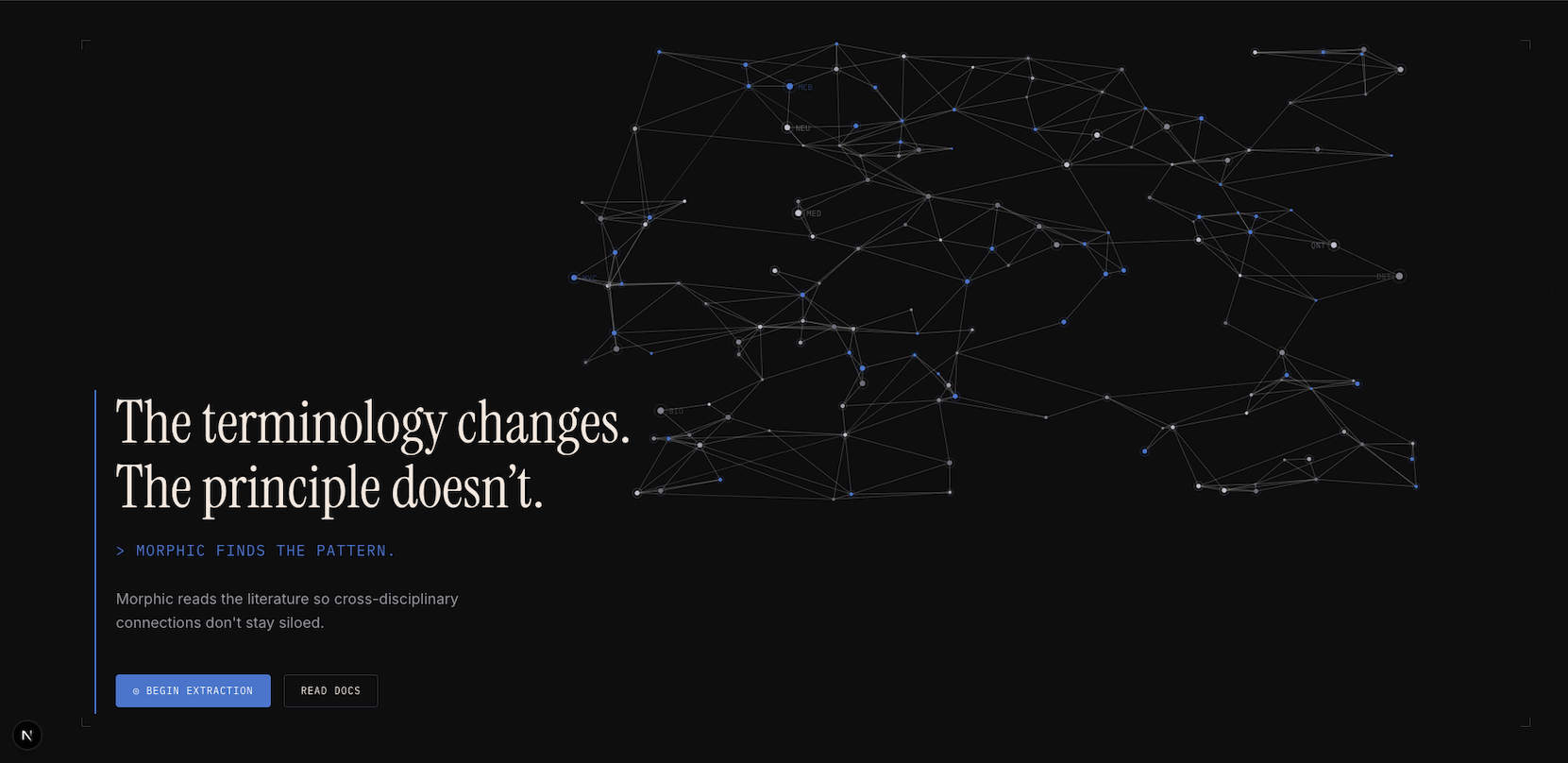
Morphic exists to find those patterns. It reads broadly, extracts the underlying structure, and tests whether it genuinely recurs across domains, organized around antifragility: systems that require stress to develop capacities they couldn't build any other way. The terminology changes; the principle doesn't.
How it works
Morphic is a multi-agent pipeline orchestrated with LangGraph. A Recursive Language Model reads a corpus of 150+ research papers and extracts candidate structural patterns. Each pattern clears a triage gate, then fans out to seven autonomous domain-specialist agents (mycology, medicine, distributed computing, microbiology, quantum physics, neuroscience, and bioelectricity), which independently judge whether the pattern manifests in their field.
This is fan-out/fan-in with quality gates, not sequential chaining: only when at least two agents fire does a pattern converge into a structured four-round dialogue (Present → Translate → Diverge → Synthesize), where each round has a distinct epistemic job, ending in a cross-domain synthesis. To date the system has surfaced 53 candidate principles and validated 37.
The parts that made it more than an API wrapper:
- Convergence gates, not forced analogies. Seven agents evaluate in parallel and only converge when multiple genuinely resonate — which keeps the system from declaring that "everything is connected."
- It verifies its own claims. Every citation is checked against Semantic Scholar, arXiv, and OpenAlex (verified / found-unverified / fabricated counts, with a transparent scoring formula), so a "pattern" rests on papers that actually exist and say what's claimed.
- Adversarial self-review. Morphic generates challenges against its own findings (rated critical / major / minor) plus falsifiability tests — so a pattern has to survive scrutiny, not just sound plausible.
- Full observability. Every LLM call is traced through Langfuse with cost, latency, and a decision audit trail.
Demo
▶ Demo video goes here
Tech stack
What I learned
- Multi-agent coordination is an architecture problem, not a prompting one — fan-out/fan-in with explicit quality gates is what makes the output trustworthy rather than just verbose.
- Verification has to be built into the system. Checking citations against real databases and running adversarial self-review is the line between something that sounds smart and something you can trust.
- A strong organizing principle (antifragility) gave the agents a shared target and kept the cross-domain search from collapsing into superficial analogy.